Showing posts with label Author to Author. Show all posts

Tuesday, 21 March 2017

Nikki Bywater On Speaking Out and Speaking Up

Words can come easy at times, they flow and grow into a perfect scene. Taken from a dream our imaginations allow us to run free and flow into our deep and darkest inner mind and we create. We invent. We have a cast of characters ready to reveal their inner secrets, feelings and emotions in a heartbeat. Anything can happen along the way. We can also take it all away in a moment. We breathe life into our characters and take readers with us along for the ride, into the escapism of our worlds.

Writing about true life events. An event that changed our life forever. Not so easy is it? Personal feelings and knowing truth and trust must be respected at all times. Just how much to reveal too. Do you kiss and tell all. Do you hold back, speak out or go away quietly and say nothing?

Sometimes some things need to be said, stories have to be told. Those words can offer comfort and help others, help others to know they are not alone. To express ones feelings through the written word often can bring comfort at the darkest of times. It can be a source of revenge for some to express feelings, feelings of pain and disappointment, feelings of despair. A chance to express your point of view, give you a chance to speak and express yourself. A chance for closure. There is nothing worse when you meet a poor communicator, especially when it is during a time when good communication really counts. When a decision out of your control can come at a high cost for someone you know best.

Sometimes people can charge ahead without knowing the full facts and jump to the wrong conclusions. You can try and speak and try to get them to listen to what you know, but if they are unwilling to listen and judge a situation on what and how they see it. The spoken word means nothing. They send you free falling into the abyss and the impossible. When we write, we can write ourselves out of any situation, in real life we are powerless and must surrender to fate. Our path was written out, we knew were we were going, but in that split second everything changed and anything could happen.

One person's wrong decision. One person's will and way. Their way, their choice. With no ending in sight and no knowing what will come next there is a word that now stands up, stronger than the rest. HOPE. Hope is always there and hope can bring change for the better. Sometimes out of the hopelessness of a situation, hope will be there, followed by love, kindness and understanding things can slowly turn around. Now we are heading towards an ending. Now we can tell our story from the beginning and it will all make sense.

So we get our pen and paper and we make a start. We follow our heart and we do it because it is the right thing to do. To be outspoken and to make a stand. To fight for what is right and what needs changing. To turn something bad into something really good...


Monday, 1 August 2016

Eight Tips I Wish I Had Known Before Becoming An Author by Lynda Spiro

Before writing There Is Always More To Say, I had never disciplined myself into writing an entire novel. I had neither the experience nor the knowledge. I just started writing down my thoughts! What I have learnt along the way has been invaluable to me. Particularly as I prepare for my next great adventure. Below are some tips which I would like to share with you. Tips that I believe have helped me to become a better writer over time.
  1. Finding my environment
    1. I found this to be incredibly important. Personally, I love writing early in the morning or late in the evening when my mind isn’t distracted by other things in my day. I love being alone with my thoughts. It also gives me more time to think, sometimes reading passages aloud or listening to music. But this is just me! Think about how and where you work best and try to make it as constructive an environment as you can.
  2. Listening to my characters
    1. I don’t always know what my characters are thinking. I don’t always know what they are about to say, or what they want to do. It’s only when I start writing that it comes to me. This isn’t because I don’t plan. But I like to be flexible and see what happens. Where I get taken to. Try to take some time to listen to your characters. You never know where they might end up taking you.
  3. Write, write, and write again!
    1. Before I wrote There Is Always More To Say, I never knew how long the writing process would take. Although I did set myself a deadline of one year! And I didn’t really think about what the process would be like. Or what it would entail. I also didn’t realise that I would not be writing the story from beginning to end. But in individual sections that I would then combine to create the whole book. Because seemingly this is what worked for me. When I wrote each piece, I would always return to it at a later date. This meant that many aspects of the story changed along the way. This was because I had the framework, but not always the details. I recommend you try the same! You never know how your fifth draft will differ from your first draft. It takes practice and refinement. Rewriting my work helped me establish the universe in which my novel was set. I hope you try the same.
  4. Story comes first – always
    1. Sometimes I wanted to take my characters on crazy adventures. This may have been because of something that had happened to me during that particular day on which I was writing, or something I had recently overheard or seen somewhere. Did it benefit the story I was trying to tell? No. Always remember the story you are trying to tell, and that the actions of your characters have reactions. Do they make sense for the novel as a whole? I learnt along the way that it’s not always either necessary or beneficial to include every idea. The story is paramount. There are always more stories to tell! There is always more to say!
  5. Leaving the comfort zone
    1. I would say that writing a novel allowed me to completely leave my comfort zone. I think it has been one of my greatest achievements to date! I loved the whole experience from beginning to end. I loved realising a project that I had never attempted before. The same should be for you. You never know where your imagination will take you by trying new things. Trust me, it is so much fun!
  6. Don’t be afraid of constructive feedback
    1. It can be a scary process when you seek feedback on a piece of work. Especially when it’s your creative baby. I found that the initial responses from a friend and also from my husband helped to propel the story into a more refined and perfected product. It really helped both me and the story. Their unanswered questions were easy for me to answer. I was given the opportunity to fix some crucial issues that I hadn’t seen whilst I’d been writing. I had left some ‘holes’ in the story. These were easy for me to fill in as they were in my head. But I had assumed that the reader knew more than I had explained. I recommend finding someone you trust and giving them snippets to review for tone and story. For me, it was my best friend and husband. For you, it could be a friend, a family member, or even a stranger! It’s extremely important to get a second pair of eyes along the way. Or maybe even a third and fourth! Whatever works best for you
  7. Always read, except for when you write
    1. I love reading, but I found it very distracting whilst I was actually writing There Is Always More To Say. This was because sometimes the tone, style, or language of the author I was reading would want to appear in my work. So although I think it’s really important to never stop reading, for me whilst writing I cannot read other people’s work for fear of being influenced by their words. Remember you want to keep your words yours. And the subconscious can do strange things.
  8. Write everyday – it is always a success
    1. Whilst I was writing There Is Always To Say, I would never let a day go by without writing anything. Even if it was just a few sentences in the notebook that I carry around with me. I wanted to maintain my flow and keep by creative style alive. It was very important to me that once I had started my novel, it wasn’t interrupted. I wanted to keep the flow, the tone, and the journey constant. That’s why I would suggest writing everyday – if only a few words. Never let your story leave your mind.

These are some of the biggest lessons I learnt whilst writing There Is Always More To Say. It was an incredibly exciting journey for me. It was difficult at times, and sometimes disheartening. But that’s what having a creative mind is! Throughout the ups and downs of writing my first novel these eight points helped me to achieve my dream. I hope they help you achieve yours. Good luck!

Lynda x

Saturday, 2 July 2016

Weaver of Dreams Nikki Bywater

All ideas have to come from somewhere and often for a writer the inspiration can come at anytime. For example there you are sitting in a nice restaurant with good company and having a wonderful evening. Then it strikes, an idea, the need to go write it down. You know you must act fast before this brilliant piece of work fades from your mind forever. It can be the same driving the car and having to pull over and write it down on whatever you can find available. At these times we never have our notebooks handy do we?

I once storyboarded on a tablecloth that belonged to a rather nice hotel in London. I just could not stop myself as the words poured out. It worked for me, sadly not for the tablecloth. Napkins are the best I find, perfect for this. I always have a pen never paper. I know even after writing this that will always be the way.

The ideas that come to you in your dreams are best. You have an amazing dream and you know it would make a good story, but then suddenly it's gone, you no longer remember or have a clue about what the dream was. You try hard in your mind to bring the memory back to the front of your ever crowded brain, but its gone.

Why do we have dreams anyway? Entertainment while we sleep? It just goes to show that we humans need to have the land of make believe in our lives. The escapism it brings. We act out whole scenarios in our sleep that are very real. People interact with us and we have sometimes logical, but then at times the weirdest of dreams, right? Not to mention nightmares. What are they all about? Sometimes people even dream and think they are awake. Sometimes people dream while being awake. What's it all about?

Many a book written too, that tell us our dreams meaning. Like there is some kind of hidden message in our dream and a purpose for it.

Dreams don't seem to come from ideas do they? They are very random, but there you are suddenly in a scene, interacting with others, like it is real and you are really there. Sometimes you can dream so deep that it takes you a few seconds to grasp where you are when you wake. Or if someone wakes you up and you are having a fabulous dream…

The writer is the dreamer, for us the dream never ends. We can create and live in a world of make believe and lose hours in our work. We can be our characters and invent their world. We have the control over their lives and destiny. For like dreams we create a succession of images, ideas and emotions. A writer is the weaver of dreams.


Monday, 27 June 2016

Join me from the Jotter by Nikki Bywater

Where does it all begin?… With, Once upon a time?… Where will it go?… From my dreams to the reality of the pages of a book? Or will it stay trapped within my minds hold forever? I have to let the words out… If I don't my words will explode in the depth of my mind, where they cannot seek light from the dark that is withheld within. So I keep them moving and a flowing. A steady stream of thoughts and ideas. I pretend I have a plan, that I know which direction I am headed, but the words carry me, they spiral into a mindset of their own. Pulling me in for the ride. Taking me with them every step of the way, guiding me from the darkness into the light. I hear nothing, I see only through a writer's eye. I hear the voices of characters calling me and telling me their tale. I sense nothing, but feel everything. I am their emotions and I create. I create a world in which they breathe. I bring them to life. I feel their pain and see their happiness. I know and predict where they are heading. I have the inside knowledge of what will become. I see the future. I can bring the words to life and see them flow and now the words are a flowing and I know which way we are going. To see them spoken and brought to life, by an actor so precise. To see them change before my eyes into a character they may despise. To feel their heart beating as we set the scene and we take our mark. To bring the words to life and turn the pages into conversation spoken out for real and we are running, time is filled as we go again and again, until we get it right and from all angles throughout the night. To lose ourselves in the role until we stop and think…

Spontaneous and Unscripted by Nikki Bywater

On a good day...


Well today was one of those lucky days… You know those beautiful, amazing and fantastic days when you write and write and write? Those days when you work through lunch and dinner and lose yourself entirely in your work. That you escape and find yourself deep in the depths of your imagination. Living in the land of make believe and finding answers and solutions to every possibility, to create a masterpiece of grouping the right words and only dropping the occasional typo for artistic affect.

When you find yourself at the crossroad between fact and fiction and think to yourself this is going remarkably well and my editor will be pleased. I am going to hit that deadline after all. You whiz through the cravings for coffee and the need to bathe and dress. Yes last nights washing up needs doing and the washer needs loading, but no, we cannot stop can we? We are addicts just a few thousand more words before bed…

Next thing you know it's 3am and you are still going fast… Now you are thinking of the reviews. How many can we collect? Will they be good? And we have not even thought of the ending and the re-writes. For today my writers nothing will stop us… We are an unstoppable writing machine…

On a bad day…


12pm and we are still not at our desks… Just one more cup of coffee should do it…. Then we are at our desks staring at our screens… When not looking out of the window or getting distracted by day time television and chatting with the neighbours on social media... Playing with our storyboarding and looking busy. Sharpening pencils, that do not need any more attention…. Scribbling on our notepads. Swinging on our chairs… Calling friends… Avoiding taking important writing telephone calls… Fretting about our deadlines… Eating cheese on toast and spaghetti hoops. Banging our heads on our keyboards… Looking holding out for that inspiration and for the words to rain down on us from a great height and fill our heads and move our fingers from tapping our keyboards in frustration, to banging words out with our keys…

Next thing you know it's 3 am and you have fallen asleep in a pool of dribble on your keyboard and all that is on your screen is iwwdhowjdwpjdddddddwdoqdwoiiiiiiiiiiiiiiiiiiiiiiiiiiiiiiiiii fffffffffffksoksororoeoroeokfckckkkkkkkkkkkkko from where your head hit the keys. You pick your self up and dust yourself down… Who knows what tomorrow may bring. 


Friday, 13 November 2015

Choosing the right name for your romantic hero in 6 easy steps! by Marie Laval

The start of a new novel is always the start of a wonderful adventure, and my very first step has to be naming my characters, especially my hero and heroine. As soon as I have done so, they become alive and turn into real persons I can talk to, dream of and shout at. Choosing the names of your romantic characters, like picking the name of your baby, can be a long and stressful process because names are full of meaning. They give the reader an immediate impression of the characters' personality and background, of their social status and physical appearance, and even of their age. A hero's name can be so attractive the reader is immediately drawn and falls in love with him, or so off-putting she will stop reading.

So, what do you need to consider when choosing a name for your hero if you write romance?

1. Consider the time period.

If you call the hero of your Regency Harley, Bailey or Zane, the reader will not find it credible and may be turned off (or indeed intrigued). On the other hand, names like Ethan or Micah which may sound at first too modern, were actually quite common in Puritan English families in the 17th century. Talking about Puritan names, you should however steer clear of Fear-God, Fly-Fornication or Die-Well for your hero!
2. Consider the setting.

If your novel takes place abroad, then it is logical to have a cast of characters with names from that country, and that includes your hero. However too may unfamiliar sounding names might put the reader off, so you may have to chose names which work well both in English and French, Spanish or Russian - or whatever nationality your hero is. For example, I think Gregor, Alexei, and Dimitri would work well for a Russian hero, whereas Ermolei, Evgeny or Miron may not work so well.

3. Consider also the letter your hero's name begins with.

I have read that it was better to give your hero a name beginning with a 'hard' letter like B, G, J, K, R, V, because a hard, tough man must have a hard, tough sounding name. Well, I may have got that right with Bruce McGunn, the hero of The Dream Catcher, but all my other heroes had names starting with supposedly 'soft' letters: H (Hugo Saintclair), L (Lucas Saintclair), and F (Fabien Coste) and yet there was nothing soft about them!

4. Consider the meaning of your hero's name.

There are many books or internet sites about the meaning of names and it's always a good idea to check first, especially when you want to use a foreign name. For example, you might find the following names lovely but be put off when you find out that Amos means 'troubled', Vaughn in Welsh means 'little', and Cameron in Scottish means 'crooked nose'!

Why did I choose Bruce? It just popped into my mind when I was thinking about my Scottish hero. I knew straight away it would be perfect for the kind of man I had in mind, and of course it was the surname of Robert the Bruce, the Scottish hero of the 14th century who achieved independence from England and became the king of Scotland.

5. That brings me to the hero's surname, which is just as important as his first name.

McGunn wasn't my first choice of surname for the hero of THE DREAM CATCHER, but then I thought it would be fun if Rose, the heroine, could make fun of him and of his dark moods by giving him nicknames such as 'McGlum' or 'McGrump'. So this is how Bruce McGunn was born!

6. Lastly, consider your heroine's name too, because the hero's and heroine's names must work well together. You should practice saying them aloud. I did and I really liked the sound of 'Bruce and Rose'.

Author Bio
Originally from Lyon in France, Marie has lived in the beautiful Rossendale Valley, Lancashire, England, for the past few years. ANGEL HEART, her debut historical romance, has just been re-released by Áccent Press, together with award-winning THE LION'S EMBRACE. She also writes contemporary romance with A SPELL IN PROVENCE, which was published earlier in 2015. THE DREAM CATCHER, Part I of her historical romance Trilogy DANCING FOR THE DEVIL, will be released on November 26th by Áccent too.

You can find her at

Blurb - DREAM CATCHER
Can her love heal his haunted heart?
Cape Wrath, Scotland, November 1847.
Bruce McGunn is a man as brutal and unforgiving as his land in the far North of Scotland. Discharged from the army where he was known as the claymore devil, haunted by the spectres of his fallen comrades and convinced he is going mad, he is running out of time to save his estate from the machinations of Cameron McRae, heir to the McGunn's ancestral enemies. When the clipper carrying McRae’s new bride is caught in a violent storm and docks at Wrath harbour, Bruce decides to revert to the old ways and hold the clipper and the woman to ransom. However, far from the spoilt heiress he expected, Rose is genuine, funny and vulnerable - a ray of sunshine in the long, harsh winter that has become his life.
But Rose is determined to escape Wrath and its proud master - the man she calls McGlum.
DREAM CATCHER is the first of the DANCING FOR THE DEVIL trilogy and is followed by BLUE BONNETS and SWORD DANCE.


Tuesday, 3 November 2015

It’s A Kind Of Magic – Book Covers! By Linn B. Halton


I’m sure many readers wonder why authors sometimes change the covers of their books. As the author of 8 novels, 3 novellas and 1 true story, most of my books are traditionally published. But three of them are self-published at the moment. Now the pros and cons for self-publishing versus traditionally publishing is another topic in itself, but it can also be one of the reasons for cover changes. In fact, there are a whole host of reasons and as I’ve just gone through a similar process with three of my novels, it’s a hot topic for me to talk about at the moment!
 

It’s often difficult to get the cover right first time, even for those who have been working in the industry for a long time. Remember that a cover has to reflect the content of the book, appeal to the readers of that genre AND stand out from the crowd.

From my personal experience this is what I’ve discovered:

A. Traditionally published books:
1. If there is a cover revision it will most likely be because the marketing team feel a change will enable the book to appeal to a wider audience.
2. Seasonal covers are popular – my Harper Impulse ‘A Cottage in the Country’ has both a summer and a winter cover, and I love that!

B. Self-pubbed books:
Being self-published means that YOU are in the driving seat: which is great on one hand, but on the other you don’t have the benefit of a marketing team’s experience to help you make good decisions. Whenever I’ve changed any of my covers it’s for one of the following reasons:

1. It’s a steep learning curve and what seemed like a great cover at the time can quickly turn out to be a BIG mistake. Don’t beat yourself up over bad decisions, just learn from it and move forward.
2. Trends change and while your book has to stand out, you want it to be easily identifiable as a part of the genre it falls within.
3. A cover may be eye-catching, but it might not quite reflect the subject matter. This makes it difficult for readers to connect with it and easier for them to pass over it.
4. As an author you will, over time, find a way of presenting information about yourself that reflects your personality. This style will be conveyed via your website, Twitter and FB accounts etc. You might then want to have an element of that tying into your covers. This is more difficult if you write in more than one genre, but can still be achieved by use of the same fonts/style/colours.
5. Linking books together, not necessarily because they are a series but, in my case, to give my three self-pubbed novels a sense of linked identity.
6. Sometimes a book that has been traditionally published is only contracted for a set number of years. When ‘the rights’ revert back to you, whether you decide to self-pub it, or submit it to another publisher, a new cover has to be designed.

Two things are very important to understand:

Beauty is in the eye of the beholder
We’re all very different…

If you look at any bookshelf you will see covers you love, covers you hate, and those that make you feel indifferent. To some people it’s the cover first, when it comes to choosing their next read. To others it’s cover AND blurb. Some people will be influenced by online reviews and personal recommendations. We are each unique and another ‘plain truth’ is that you can’t please everyone all of the time. Me? I go with my heart and my gut instincts, tempered more and more by experience as time goes on.

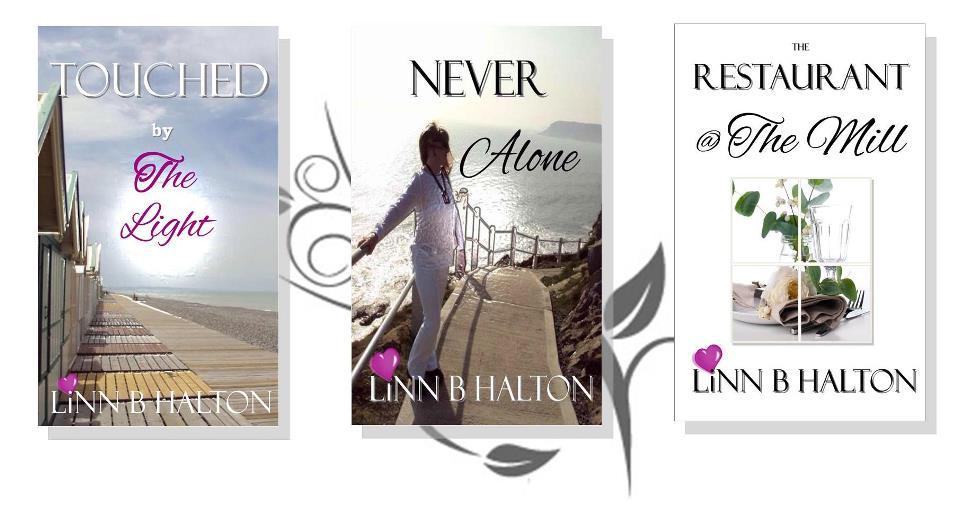
My latest cover changes were triggered by getting the rights back for The Restaurant @ The Mill. It seemed the right time to give my self-pubbed books a sense of linked identity. But the new covers also reflect the way I’m feeling more comfortable with my own style. The important thing is to realise that nothing stands still in this fast-paced world and to embrace everything change has to offer – including new directions!
C:\Users\Linn\Desktop\Var Graphics\Promo graphics\Linn B Halton new covers med.jpg


If you want to read about the photo shoot for the new Never Alone cover, you can read the story here: http://linnbhalton.co.uk/my-first-photo-shoot/. It’s just one example of … let’s say ‘diversity’, for this writer!

You can visit me at:

Saturday, 5 September 2015

A word from Kate Long

I don’t know if you caught the Twitter trend #WhyIWrite, but it was fascinating. There were the obvious responses – ‘To quieten the voices in my head’, ‘To explore my deepest feelings’, ‘So that I can live forever’  and, more prosaically, ‘Because real life sucks.’ There was humour: ‘It’s a great way to avoid housework’. Then the inevitable backlash.
C:\Users\Public\Pictures\BMH covers\WhyIWrite pretentious   Twitter Search.png
You can always rely on Twitter for the full range of views.


But the discussion got me thinking. Yes, there were responses that chimed with me, especially those which spoke about the need to escape reality. Books have always provided a haven that way whichever end of the process we’re at, as authors or readers, creators or consumers.
I knew, though, that there were also impulses that were more specific to me. I’m guessing all writers have these very personal writing dynamics. For instance, there are themes to which I return repeatedly – family secrets, eating disorders, sexuality, adoption. I’m drawn to those issues and the narratives that can come out of them. I want to explore my ideas on these topics and learn more by developing them in a story. This leads me to further research, which in turn sparks off more writing.
Then there’s what I want to say about the world. Real life does suck at times, no doubt about it. Good people suffer horrendous misfortune, and evil-doers often seem to dance through their days. So as a reader, when I open a book I like to step into somewhere more balanced and just, and the same is true for when I write. The characters of mine who are decent always do triumph, and my villains are punished. Perhaps the triumph isn’t unalloyed, and perhaps my heroines don’t end up with exactly what they thought they wanted. But the endings are essentially happy because I have that power and can make them so. Sometimes we all need a break from the unfair chaos around us.
Why do we write? It’s a question authors need to ask themselves because there are times when things are not going well, we’ve had bad reviews and we’re lonely or discouraged, or the muse has packed up and gone on holiday. What incentive is there to carry on? Well, here’s the best I’ve found, the one that’s saved me several times. Above all else, don’t we write to make connections with people? If energy’s low and spirits bleak, then remembering praise from readers is the best tonic there is. We write to entertain, to cheer, to affirm. We write to stretch out a hand.
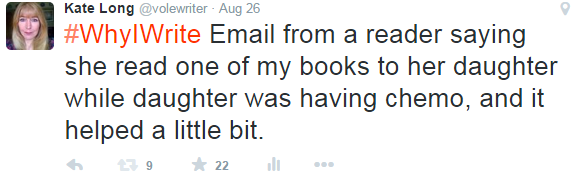
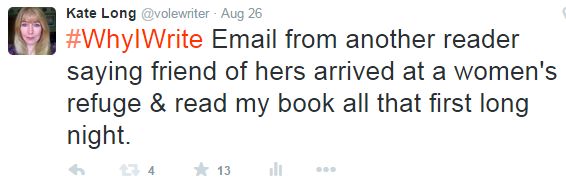
After some thought, here’s what I finally tweeted in response:
C:\Users\Public\Pictures\BMH covers\Kate Long   volewriter    Twitter4.png
C:\Users\Public\Pictures\BMH covers\Kate Long   volewriter    Twitter3.png
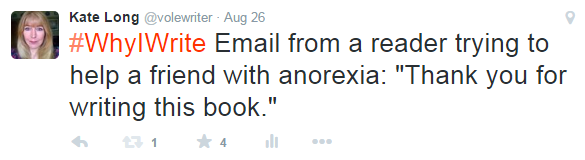
and with my most recent book:
C:\Users\Public\Pictures\BMH covers\Kate Long   volewriter    Twitter2.png
If my novels have made even one person feel better-placed to face the world, then I’ve not made a complete hash of it. And what’s more, I’ll carry on writing.


Sunday, 15 March 2015

A word from Daniel O'Leary

Well, I have finally boarded the rush hour train of authorship, crowded with a new styled writer, as desperate as the next to secure a seat at the banquet of success. The  positions available are far outnumbered by those who would seek to partake of the rich and sumptuous feast on offer but this is not sufficient deterrent to those who push and barge and fight to get to the table, and I am no different. The opportunities that currently present themselves to any soul who wants to take up the pen or tap at a keyboard are innumerable; the prevalence of self-publishing outlets, the resources that a solitary storyteller can now exploit to promote themselves, formidable. But of course, such a wealth of outlets engenders its own set of problems, not least the competition vying for a share of the cake from that banquet ever inflating in number. The choice for the reader is overwhelming; some would say the avalanche of material on offer drowns individual quality, buries it in the abyss of anonymous irrelevance. Others may say that there is a danger that the number of writers will eventually surpass the number who actually read…

This then, is the backdrop, the landscape that hovers over the arena into which for the first time after 54 years on the planet, I have chosen to enter. But enter I have and my first effort, ‘The Loss of  Mother’ by me Daniel O’Leary, available on Amazon in kindle and paperback form is littered with typing errors, one of the perils of self-publishing and self-editing and yet, despite this undeniable and empirical fact, some of the reviews have humbled me, indeed, some of their content more seductive than the substance within my work. Am I put off by the competition? Not a bit of it. Am I put off by the improbability of likely success? Not at all. Why do I do it? Because if even one person can extract pleasure from something I have penned, then I have indeed been successful! So be ennobled, stiffen the sinews and summon the blood! Let slip the dogs of war and PUBLISH AND BE DAMNED!!!!    


Wednesday, 4 March 2015

Blocked by Margaret Blake


Where am I today? In a place I never thought I would be. Is this the end of me as a writer? These are questions buzzing around in my head since I have been unable to sustain one of my novels. I have three at 25,000 words and can’t seem to get past that.

Actually I can feel physically sick when I think about doing some work. It’s a new feeling for me because I have been known to have three books on the go. Why does it happen? Who knows for sure? I read of lots of cures but none of them work.

It stems I think from losing John, my husband and friend. He was always my inspiration; he would never allow me to not write. And it was great to be able to talk to him about plots and characters. Alone now there is no one to bounce ideas off. Lots of friends but it just isn’t the same. My dread moment comes when someone asks me “What are you working on at the moment,” and I have nothing to say!

My last novel The Flowers Girls has proven popular but it was the first book I wrote on my own without John’s encouragement. I can do it...if only...

Review – The Flower Girls by Margaret Blake, published by Whiskey Creek Press.
“An intriguing tale – an emotion-packed romantic suspense that will keep you guessing. Mystery, suspects aplenty, secrets, adultery, murder, passion and love intertwine to give readers a captivating read. Ms Blake’s skilful prose puts reader right into the midst of her story and I for one, am interested in seeing what she comes up with next.
Dottie – Romance Junkies. For full review go to www.romancejunkies.com